
On construction engineering sites, steel rebar cutting and welding run through almost the entire construction cycle. From foundation work, main structural construction to steel processing yards, a large amount of rebar cutting, welding connections, and local finishing work are required every day. In order to ensure construction efficiency, a stable and safe gas supply method has become a key concern for many contractors. As an important component of the oxy-acetylene cutting and welding system, acetylene cylinders can provide continuous and stable combustible gas for rebar cutting, rebar welding, steel structure installation and other operations. Proper selection of acetylene cylinder specifications, standardized installation of gas supply systems, and good daily management can not only reduce downtime waiting, but also improve construction efficiency, reduce gas waste, and make the whole construction process smoother. The following introduces a relatively complete acetylene cylinder supporting solution based on on-site rebar cutting and welding conditions.
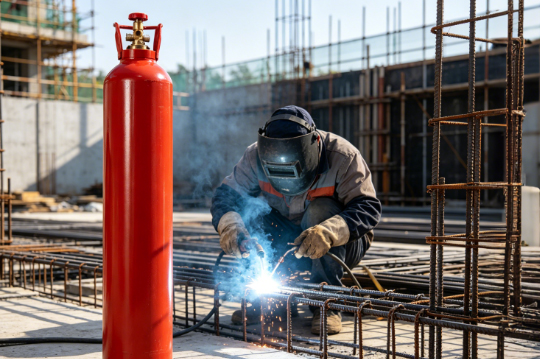
The Role of Acetylene Cylinders in Rebar Cutting and Welding on Construction Sites
Why Stable Acetylene Supply Is Needed in Rebar Construction
Rebar cutting and welding are highly continuous construction processes. If the gas supply fluctuates, the flame will easily change, which not only affects cutting speed but may also cause uneven cutting surfaces, reduced weld quality, and even increase rework rates. Construction sites usually have multiple working areas operating simultaneously with long working hours. If acetylene supply cannot remain stable, workers need to frequently replace gas cylinders, which not only affects construction rhythm but also increases on-site management workload. Therefore, many engineering projects configure acetylene cylinders with suitable capacities according to construction scale, and equip them with pressure reducing valves, flashback arrestors, and gas pipelines to ensure a more stable gas supply process. Different construction stages also have different gas demands. For example, rebar processing areas require continuous cutting, while main structure installation focuses more on welding quality. Therefore, reasonable planning of acetylene supply schemes is very important.
How Acetylene Cylinders Work with Rebar Cutting and Welding Equipment?
Acetylene cylinders do not work alone. They are usually part of a complete cutting and welding system together with oxygen cylinders, pressure regulators, flashback arrestors, welding and cutting torches, and gas hoses.
| Supporting Equipment | Main Function | Benefit to Construction |
| Acetylene cylinder | Provides combustible gas | Ensures continuous combustion |
| Oxygen cylinder | Provides supporting oxygen | Improves cutting efficiency |
| Pressure regulator | Controls output pressure | Stabilizes flame |
| Flashback arrestor | Prevents flame backflow | Improves safety |
| Welding/cutting torch | Performs cutting and welding | Completes on-site work |
| Gas hose | Transports gas | Maintains stable supply |
Workers can adjust flame size according to rebar specifications, making cutting speed and welding quality more balanced.
Requirements for Acetylene Cylinders in Different Construction Environments
Construction environments vary greatly, including outdoor sites, basement construction, and large factory building projects. Therefore, acetylene cylinders must be placed appropriately according to the working environment. Outdoor construction requires sun protection and rain protection to avoid long-term exposure; underground construction requires good ventilation to prevent gas accumulation; in high-temperature weather, inspection frequency should be increased to check whether valves and connections are normal. Proper placement of acetylene cylinders not only facilitates operation for workers but also helps reduce equipment wear and improve on-site management efficiency.
How to Achieve Stable Gas Supply in Rebar Cutting and Welding?
Configuring Gas Supply Schemes Based on Construction Scale
Different projects have significantly different acetylene consumption. Small construction sites can generally meet daily needs with a single-cylinder supply; medium and large sites often use multiple sets of acetylene cylinders in rotation to reduce downtime; large rebar processing centers may even adopt centralized gas supply systems to allow multiple cutting machines to operate simultaneously. Before construction, a simple estimation can be made based on daily cutting length, welding workload, and team size to select appropriate gas supply configurations, avoiding insufficient supply or long-term equipment idling.
Standardized Installation of Gas Supply Systems
During installation, all components should be connected according to equipment manuals, and sealing conditions should be checked.
• Check whether the acetylene cylinder valve opens normally.
• Confirm stable pressure after installing the regulator.
• Check whether hoses are aged, cracked, or leaking.
• Observe whether the flame color is uniform and stable after startup.
Although these steps are basic, they directly affect construction experience. Many construction sites assign dedicated personnel to inspect equipment daily before work starts to keep equipment in good condition.
Maintaining Continuous and Stable Gas Supply During Construction
During continuous operation, frequent opening and closing of valves should be avoided to prevent unstable output. Project supervisors can prepare spare acetylene cylinders in advance according to daily tasks and switch quickly when replacement is needed to reduce waiting time. For centralized rebar processing areas, gas cylinders can be placed in fixed locations and connected to equipment through longer hoses, which is not only convenient for management but also reduces on-site handling.
Detail Management Affecting Rebar Cutting and Welding Efficiency
Daily Inspection and Maintenance of Acetylene Cylinders
Many gas supply issues on construction sites are not caused by equipment defects, but by lack of daily inspection. Before work each day, check whether the cylinder body is intact, valves are flexible, connections are tight, and pressure is normal. If any abnormality is found, stop using immediately and handle it properly. After work, close valves, organize gas hoses, and place equipment in designated areas for next-day use. Standardized maintenance not only extends equipment life but also reduces construction interruptions.
Reasonable Construction Sequencing to Reduce Gas Waste
Rebar processing usually includes measurement, cutting, bending, and welding. If the sequence is properly arranged, rebar of the same specification can be cut in batches and then welded together, reducing frequent equipment start-stop cycles and improving gas utilization.
| Construction Stage | Suggested Practice | Result |
| Rebar cutting | Centralized cutting | Higher efficiency |
| Rebar welding | Zonal operation | Reduced waiting time |
| Equipment inspection | Once per shift | Lower failure rate |
| Cylinder replacement | Prepare spare in advance | Ensure continuous operation |
Good construction arrangement allows equipment to maintain stable operation and reduces the time workers spend repeatedly adjusting flames.
Strengthening On-Site Standard Management
Construction sites involve many workers and simultaneous operation of various machines, so a well-structured management system is necessary. Acetylene cylinders should be placed in designated areas with clear signage; avoid violent collisions during transportation; use dedicated carts for handling instead of rolling cylinders randomly; and count equipment after work. Although these measures seem simple, they help keep the site clean and organized and improve overall efficiency.
Building a More Efficient Rebar Cutting and Welding Solution
Matching Equipment Selection with Construction Needs
With the continuous expansion of construction projects, contractors pay more attention to whether equipment configuration matches actual needs. If daily workload is large, larger-capacity acetylene cylinders can be selected with spare cylinders to ensure continuous operation. For more mobile projects, transport convenience and flexibility are more important. Reasonable equipment configuration not only improves efficiency but also facilitates unified site management.
Establishing Standardized Construction Procedures
Mature construction teams usually develop unified operating procedures. From equipment entry inspection, installation and debugging, formal construction, daily inspection, maintenance, to end-of-day storage, each step has clear requirements. Standardized processes reduce operational differences, ensure consistent construction quality across teams, and make supervision easier for project managers.
Continuous Optimization of On-Site Gas Supply Management
As construction progresses, the amount of rebar processing changes and gas demand also fluctuates. Project managers can adjust cylinder delivery plans based on actual daily consumption, prepare spare equipment in advance, and avoid delays caused by insufficient supply. Once a standardized gas supply management system is established, rebar cutting, welding, equipment maintenance, and on-site coordination all become smoother, improving overall construction efficiency.
Q&A
How often should acetylene cylinders be replaced during rebar cutting and welding on construction sites?
There is no fixed answer, as it mainly depends on construction intensity, cylinder capacity, and daily gas consumption. For small-scale rebar processing, one cylinder can last a long time. For large construction sites with multiple teams working continuously, gas consumption is much faster, and replacement may be required daily or even multiple times per day. Therefore, it is recommended that contractors calculate daily gas usage based on actual construction plans and prepare sufficient spare acetylene cylinders to avoid downtime due to gas shortage. At the same time, regularly check cylinder condition, valve sealing, and supporting equipment to ensure stable and safe gas supply. For long-term projects, establishing a cylinder usage record and replacement plan also helps improve site management efficiency and reduce time loss caused by emergency adjustments.
A well-designed acetylene cylinder solution is not only about supplying gas, but also an important guarantee for maintaining stable construction operations on-site. From equipment selection, standardized installation, daily inspection, to construction scheduling and gas supply management, if each step is properly executed, construction efficiency will naturally improve, and cutting and welding quality will become more stable. For long-term projects, establishing a standardized gas cylinder management system can reduce equipment failures and downtime, making construction progress smoother. Choosing reliable acetylene cylinders and supporting equipment, combined with scientific on-site management methods, can provide continuous and stable gas support for construction projects, while also making operation safer and more reliable for workers, ensuring solid support for project completion on schedule. If you are looking for a reliable industrial gas cylinder supplier, feel free to contact Zhongcheng Gas Cylinder Co., Ltd. We will provide professional product solutions and service support according to your project needs.