
In scrap recycling yards, propane cylinders are involved throughout the entire workflow, including scrap steel dismantling, metal cutting, equipment removal, and on-site cleanup. The site is often filled with metal debris, oil stains, welding sparks, vehicle movement, and frequent personnel traffic. Once cylinders are placed improperly, issued without clear records, or inspected inadequately, small issues can quickly turn into safety hazards. For recycling yards, propane cylinder management is not just a storage task, but a complete solution covering storage, use, inspection, and traceability. When management is handled in detail, the site becomes more stable and operational efficiency is easier to improve.
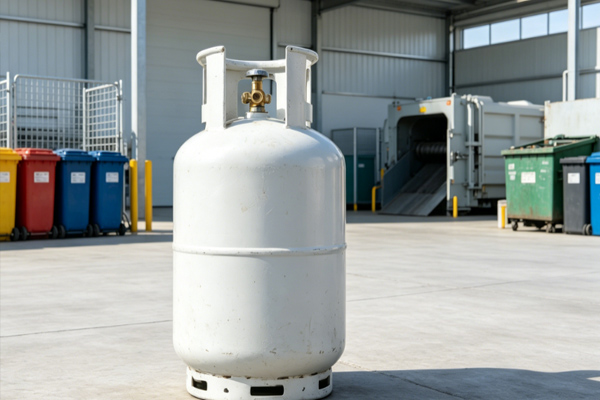
Why Do Scrap Recycling Yards Need a Propane Cylinder Management System?
The working environment in scrap recycling yards is complex, cylinder usage is frequent, and management difficulty is far higher than in ordinary settings.
Complex Working Conditions Create Overlapping Risks
What is common in recycling yards is not a single risk, but a compound risk scenario where sparks, oil stains, waste materials, vehicles, and personnel movement all exist at the same time.
- During metal cutting, sparks fly everywhere. If combustible materials are stacked too close, they may be ignited in a short time, and on-site response pressure will increase significantly.
- After dismantling old equipment, residual oil, plastic, and dust remain. These materials are more sensitive in high-temperature, friction, or open-flame environments, making risks escalate quickly.
- Vehicles move frequently for transport, and cylinders are easily bumped, squeezed, or misplaced during handling, transfer, and temporary placement, which affects operational safety.
When these factors overlap, the safety margin of propane cylinders is continuously compressed. The value of a management system lies in turning scattered risks into controllable processes.
High Usage Frequency but Inconsistent Management Standards
Many recycling yards follow the habit of “whoever uses it takes it, and puts it back after use.” While this may seem convenient in the short term, it gradually makes management more and more loose over time.
- Different teams operate in different ways, which leads to deviations in on-site execution standards and makes it difficult for managers to enforce unified requirements.
- There are no fixed records for issuing, returning, or inspecting cylinders, so the circulation process lacks evidence and later tracing becomes very difficult.
- Empty cylinders, full cylinders, and cylinders pending inspection are often mixed together. When their status is unclear, the probability of misuse and mistaken use rises significantly.
Without unified standards, the site may appear to function normally, but in reality it lacks traceability. Once a cylinder becomes abnormal, it is difficult to quickly identify the responsible link.
Core Components of a Propane Cylinder Management System
A practical management solution cannot remain at the slogan level; it must cover the entire process.
Cylinder Storage Standard System
The storage area is the first line of defense in cylinder management. Only by standardizing storage can later use and inspection have a stable foundation.
- Set up an independent area to avoid mixing cylinders with miscellaneous items, oil products, or waste materials. This reduces external interference and makes the site boundaries clearer.
- Keep the area ventilated, shaded, and rainproof to reduce environmental impact on cylinders and avoid additional risks caused by high-temperature exposure or humid conditions.
- Store full cylinders, empty cylinders, and cylinders pending inspection in separate zones so their status is clear at a glance and both managers and operators can identify them quickly.
The more detailed the storage standard, the easier it is to establish order on site. For recycling yards, a clear storage structure also reduces handling time and lowers the chance of taking or using the wrong cylinder.
Usage and Dispatch Management Mechanism
Once cylinders enter the operation stage, management focus shifts to the usage process. Whether dispatch is clear directly determines whether the site is easy to lose control of.
- Establish a checkout record system that records the user, time, purpose, and return status so the whereabouts of each cylinder can be clearly tracked.
- Control the number issued at one time to avoid excessive cylinders being stacked on site, reduce pressure in temporary areas, and lower concentrated risks.
- Define the responsible person clearly so that “whoever takes it is responsible, whoever uses it is responsible, and whoever returns it is responsible,” making the management chain more complete and making it easier to trace problems when they occur.
The clearer the dispatch mechanism, the less likely the site is to experience lost cylinders, mistaken use, or excessive usage. For high-frequency operation scenarios, this step directly affects both efficiency and safety.
Common Management Problems and Comparative Analysis in Scrap Recycling Yards
Many accidents do not appear suddenly; they are the result of long-term accumulation.
Disorganized Storage Areas
When cylinders do not have fixed positions, site order deteriorates quickly, and simple actions such as finding, moving, or replacing cylinders become more time-consuming.
- Full cylinders and empty cylinders are mixed together, making it easy to misjudge their status. Even in emergencies, on-site personnel cannot identify them quickly.
- Cylinders are stacked against walls, blocking passageways. Transport routes become compressed, affecting normal movement and emergency evacuation.
- When mixed with waste materials, tools, and oil drums, risks rise significantly and management difficulty increases accordingly.
This kind of disorder not only affects safety, but also slows down daily cylinder finding, moving, and replacement.
Missing Usage Procedures
Without procedures, management is difficult to close the loop, and the site easily develops a habit of handling things based on experience.
- No record is made when cylinders are issued, so their whereabouts cannot be traced. If a problem occurs, it is difficult to determine at which stage the cylinder went wrong.
- Usage duration is not recorded, making it difficult to assess consumption. Later replenishment and allocation also lack a basis.
- Responsibility boundaries are vague, making accountability difficult when problems arise, and on-site personnel may become dependent on experience-based handling.
Missing procedures leave cylinder management in a state where it can be seen but not controlled.
Comparison of Management Methods
The differences in safety, efficiency, and cost control among different management methods directly determine the effectiveness of propane cylinder management at waste recycling sites.
| Management Method | Features | Safety Level | Operational Efficiency |
| Traditional Loose Management | No fixed process, operation based on experience | Low | Unstable |
| Basic Standard Management | Simple rules, incomplete execution | Medium | Average |
| Standardized Management | Full-process records, clear responsibilities | High | Stable |
| Intelligent Management | Data-based monitoring, real-time tracking | Very High | Efficient |
From a practical perspective, standardized management can already solve most on-site problems. If the recycling yard is large and cylinder usage is frequent, intelligent management is more suitable for long-term operation.
Key Measures to Optimize Propane Cylinder Management
To truly implement management, the focus should be on systems, execution, and inspection working together.
Zoning Management and Identification System
Establishing a zoning and labeling system is the first step in implementing propane cylinder management.
- Clearly define the storage area, usage area, pending-inspection area, and empty-cylinder area so that each type of cylinder has a fixed location and site order becomes clearer.
- Set up prominent signs to reduce misplacement and mistaken pickup. Especially in environments with high personnel turnover, signage can significantly reduce operational errors.
- Use colors, numbers, or labels to distinguish cylinders in different states, making it easier for managers to identify them quickly and for teams to follow the same rules.
A clear identification system allows new employees to quickly understand site rules and reduces human error.
Standardized Operating Procedures
For propane cylinder management to be truly implemented, process standardization is the most direct approach.
- Establish a fixed process for requisitioning, returning, inspecting, and reporting abnormalities, ensuring that each step has a clear action and corresponding responsibility.
- Standardize operating actions to reduce differences between teams and avoid different personnel handling the same type of issue according to different habits.
- Establish a responsibility traceability mechanism to create a closed loop. Once an abnormality occurs, the corresponding link can be quickly identified.
After procedures are standardized, management no longer depends on personal experience, and on-site execution becomes more stable.
Regular Safety Inspection System
Establishing a regular inspection schedule is key to effective propane cylinder management.
- Conduct basic daily inspections, focusing on appearance, valves, and placement status, so obvious abnormalities can be found and handled quickly.
- Conduct weekly systematic inspections of accessories, pipelines, and records to ensure equipment status matches ledger information.
- Conduct monthly comprehensive reviews to summarize issues and optimize the system so that management measures can be adjusted as the site changes.
Inspection is not a formality; it is about eliminating hidden risks before operations begin.
The key to propane cylinder management in scrap recycling yards is not just placing cylinders properly, but managing every link clearly, carefully, and thoroughly. Through standardized storage, process control, regular inspections, and status tracking, recycling yards can reduce safety risks and improve operational efficiency. As the recycling industry continues to upgrade, systematic cylinder management is no longer an optional add-on, but an essential foundation for stable business operations. Zhongcheng Gas Tanks provides professional propane cylinder and industrial gas management support solutions to help recycling yards achieve safer and more efficient operations.