
In the hardware processing industry, acetylene gas is widely used in welding, cutting, heating, and other process operations. Its stability and safety directly affect production efficiency and operational safety. As hardware manufacturing moves toward greater precision and higher efficiency, the standardized installation of acetylene tanks has become increasingly important. A scientific and reasonable installation scheme not only improves gas supply stability but also reduces safety risks and ensures long-term stable workshop operation. This article provides a systematic analysis of installation requirements, standard procedures, safety management, and equipment selection to help enterprises build a more efficient acetylene gas supply system.
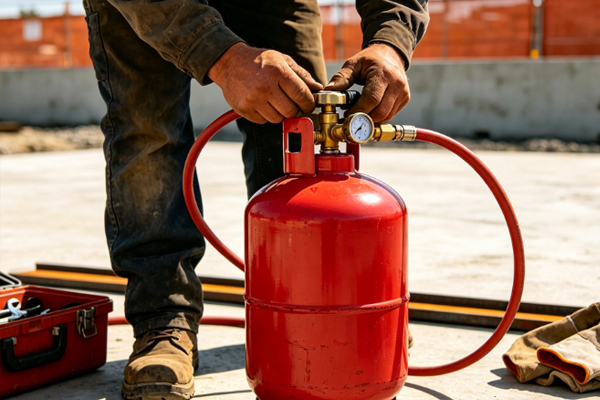
Why Must Acetylene Tank Installation Be Standardized in the Hardware Industry?
Standardized installation is the fundamental prerequisite for ensuring production safety and efficiency.
Ensuring Safe Production Operation
Hardware workshops have complex environments with frequent ignition sources and high-temperature operations. Only by standardizing acetylene tank installation from the source can a basic safety barrier be established for the entire production environment.
- Reducing leakage risks: Standard installation reduces loose connections, prevents gas leakage accidents, and improves overall system sealing.
- Preventing flashback and explosion: Installing flashback arrestors helps control gas backflow risks and improves operational safety levels.
Through standardized installation and continuous management, the overall safety level of the workshop can be further improved.
Improving Gas Supply Stability
Stable gas supply is the key to ensuring processing quality. Only with stable gas supply can continuous and efficient hardware processing be guaranteed.
- Reducing pressure fluctuations: Proper pipeline layout helps maintain stable output pressure.
- Improving equipment efficiency: Avoid frequent shutdown adjustments and ensure continuous welding and cutting operations.
This further enhances overall production efficiency.
Standard Installation Process for Acetylene Tanks
A standardized process ensures safe and controllable installation and lays the foundation for long-term operation.
Site Selection and Basic Requirements
The installation location directly affects safety and efficiency. Scientific site selection is the first step for safe system operation. The installation area should have good ventilation to ensure air circulation, be kept away from enclosed spaces, and be distant from fire sources and high-temperature areas. It should also maintain a safe distance from welding operation zones and avoid direct sunlight exposure.
Installation Structural Standards
A standardized structure is the foundation of safe operation. A reasonable structural design can significantly improve equipment stability and service life.
- Fixing and anti-tip design: Use dedicated brackets to secure acetylene tanks and prevent accidental tipping due to collisions.
- Standardized pipeline connections: Use pressure-resistant hoses with reliable and well-sealed joints.
Regular inspection of sealing and fastening conditions at all connection points can further reduce leakage and safety risks.
Safety Accessory Configuration
Safety devices are the core protection of the system. A complete safety configuration is an important defense line against accidents. Flashback arrestors, pressure regulators, and pressure gauges must be installed and fully configured. In addition, auxiliary safety devices such as gas leak alarms and emergency shut-off valves should be equipped to enhance emergency response capability.
Key Parameter Reference Table for Acetylene Tank Installation
Standardized parameters help quickly verify whether installation meets requirements.
| Item | Standard Requirement | Description |
| Installation environment | Well-ventilated, dry | Avoid humid and enclosed spaces |
| Distance from fire source | ≥10 meters | Prevent high-temperature hazards |
| Fixing method | Dedicated bracket or anti-tip device | Ensure equipment stability |
| Pipeline material | Pressure-resistant rubber or metal hose | Prevent aging and rupture |
| Safety devices | Flashback arrestor + pressure regulator + pressure gauge | Must be fully configured |
| Inspection cycle | Once per week | Ensure stable system operation |
The above parameters serve as important reference standards for acetylene tank installation and operation. Enterprises should strictly implement them according to actual site conditions.
How to Improve Safety and Efficiency of Acetylene Gas Supply Systems?
On the basis of standardized installation, management and optimization are also required to improve overall operational performance.
Establish a Standardized Management System
Standardized management is the foundation of long-term safe operation. Only with a complete system can the acetylene system operate stably and reliably over time.
- Unified operating procedures: Clearly define gas switching steps and standardize ignition and shutdown processes.
- Personnel training system: Conduct regular safety training to improve operational proficiency.
Through continuous optimization of the management system, system safety and operational efficiency can be further improved.
Regular Maintenance and Inspection
Equipment condition directly affects operational safety. Continuous maintenance is an important means to ensure stable system operation. Daily inspection includes checking whether pipelines are aging and whether joints are loose. Periodic maintenance includes replacing aged hoses and cleaning impurities in pressure regulators.
Optimizing System Layout
A reasonable layout improves overall efficiency. Scientific layout can significantly enhance gas supply efficiency and operational convenience.
- Combination of centralized and zoned layout: Centralized management for main gas supply areas and flexible allocation for operation zones.
- Reducing transmission loss: Shorten pipeline distance and improve gas utilization efficiency.
This further ensures stable workshop production operation.
Application Advantages of Mobile Acetylene Generators in the Hardware Industry
With the upgrading of production methods, flexible gas supply equipment has become an important supplementary solution.
Providing a More Flexible Gas Supply Method
Combined with the Zhongcheng gas tank mobile acetylene generator, workshop adaptability can be effectively improved. Flexible gas supply methods are becoming an important choice for improving efficiency in the hardware industry.
- On-site gas generation is more efficient: Using calcium carbide gas generation, gas is produced and used immediately without frequent cylinder replacement.
- Easy mobility: After adding water, the total weight is about 30kg, allowing single-person transport and use.
In practical applications, it can be flexibly deployed across different workstations to further improve overall production efficiency.
Improving Overall Production Efficiency
Flexible gas supply not only improves convenience but also optimizes the overall production rhythm.
- Reducing transportation and replacement costs: Decreases reliance on bottled gas and improves supply continuity.
- Supporting multi-station operations: Meets simultaneous use at multiple welding points and improves overall workshop efficiency.
At the same time, flexible gas supply solutions also help enterprises further improve refined production management.
Acetylene tank installation in the hardware industry should follow the principles of standardization, safety, and systematization. From site selection to equipment configuration and daily maintenance, every step affects production safety and efficiency. By implementing a scientific installation scheme combined with flexible gas supply equipment, workshop performance can be significantly improved. The Zhongcheng gas tank mobile acetylene generator provides a safer and more efficient industrial gas supply solution for the hardware industry.