
The hardware manufacturing industry covers multiple stages such as metal processing, parts assembly, welding finishing, heat treatment, and equipment maintenance, all of which place high demands on the stability, flexibility, and safety of heat supply. Industrial propane cylinders, with their continuous gas supply, easy mobility, and broad application scenarios, have become a common energy configuration solution for many hardware enterprises. To truly make propane cylinders effective, it is not enough to look at the equipment itself; overall planning must also be combined with process flow, site layout, and management methods so that efficiency, cost, and safety can all be taken into account.
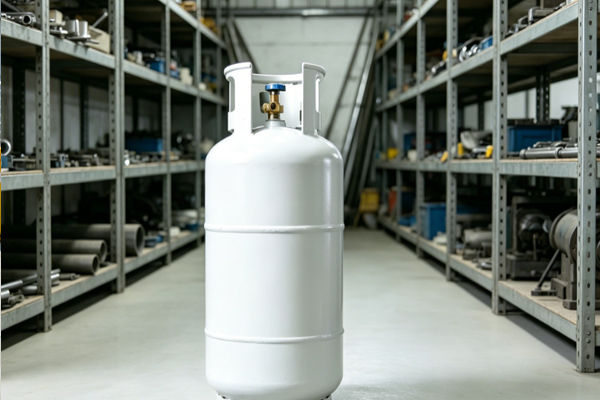
Adaptation Advantages of Industrial Propane Cylinders in the Hardware Industry
The hardware industry involves many processes and dispersed workstations, and industrial propane cylinders offer clear advantages in such an environment.
Suitable for a Variety of Thermal Processing Needs
Propane burns stably and delivers heat evenly, making it suitable for many processing stages. For hardware enterprises, many processes do not require extremely high temperatures, but they do rely heavily on the continuity and controllability of the heat source.
- During metal material preheating, the heat distribution is more even, allowing the workpiece to heat up more smoothly and reducing processing deviations caused by excessive local temperature differences.
- In pipe bending operations, a stable heat source can improve material ductility, making the operation smoother while reducing the risk of cracking and excessive springback.
- In local baking and finishing stages, propane cylinders can provide continuous heat, allowing operators to control the processing pace and final product quality more precisely.
In actual production, a stable heat source helps improve processing consistency and reduces quality differences caused by temperature fluctuations. For batch-produced hardware parts, this stability means fewer reworks, a higher yield rate, and stronger delivery assurance for the enterprise.
Adaptable to Flexible Production Environments
Many hardware enterprises have temporary workstations, mobile workstations, and multi-area operation requirements, which fixed gas supply methods often cannot fully cover. The advantage of industrial propane cylinders lies in their flexible deployment; they do not rely on complex pipeline networks and can quickly enter production status.
- Temporary workstations can be connected to a heat source quickly, reducing setup time and allowing production tasks to move into execution faster.
- Mobile workstations are more convenient to use, suitable for multi-point rotating operations, and can follow the process flow, reducing waiting and handling costs.
- In on-site construction scenarios, cylinders can be adjusted according to the work location, improving response speed, especially in environments with limited space or frequently changing tasks.
This flexibility makes on-site scheduling more efficient and is better suited to multi-batch, small-batch production models. For enterprises with fast-changing orders and frequent process switching, propane cylinders are not only an energy tool but also an important configuration for improving production response speed.
Typical Application Scenarios of Industrial Propane Cylinders
In hardware production, propane cylinders are not just a single-purpose heating tool, but a supporting energy source for multiple processes.
Auxiliary Heating Before Welding
Preheating materials before welding helps improve processing results. Many hardware parts are affected by material thickness, ambient temperature differences, and structural complexity during welding. If operated directly, issues such as uneven weld seams and localized stress concentration may occur.
- After preheating, the material heats more evenly, making the welding process more stable and allowing the weld seam to form more naturally, which also makes subsequent finishing easier.
- For thick plates or irregular parts, preheating can reduce welding deformation and help maintain better dimensional accuracy and assembly consistency.
- For processes with higher weld quality requirements, preheating improves product consistency and reduces internal stress caused by temperature differences.
This method is suitable for processing various metal parts, especially for processes with high weld quality requirements. Through preheating, localized deformation can be reduced, welding stability can be improved, and the service life of finished products can also be extended.
Metal Surface Treatment
Some processes require a continuous and even heat source, and propane cylinders also play an important role in surface treatment. Operations such as workpiece drying, preheating before spraying, and removing surface moisture all depend on stable heat support.
- During workpiece drying, stable heat can shorten waiting time, making the production rhythm tighter and reducing subsequent problems caused by moisture.
- Preheating before spraying helps improve coating adhesion, making the treated product more durable and the appearance more uniform.
- After surface moisture is removed, the defect rate in subsequent processes can be reduced, avoiding bubbling, peeling, or poor adhesion.
Even heating can improve the quality of subsequent processes and reduce rework in surface treatment. For the hardware industry, surface treatment is not only related to appearance, but also to rust prevention, corrosion resistance, and product durability.
Equipment Maintenance and On-Site Construction
Maintenance areas often do not have fixed gas supply conditions, making mobile cylinders more advantageous. In equipment maintenance, pipe repair, and on-site installation, hardware enterprises often face limited space, tight schedules, and frequently changing workstations.
- During emergency repairs, thermal processing capability can be restored quickly, helping the enterprise minimize downtime and reduce losses caused by production interruptions.
- In on-site installation, cylinders can adapt to different work locations, allowing maintenance personnel to maintain high operational efficiency even in complex environments.
- For temporary construction tasks, dependence on fixed pipeline networks is reduced, making heat source configuration more flexible and better suited to sudden task arrangements.
This application method can shorten downtime and is especially practical for emergency repairs and urgent operations. If an enterprise can quickly restore thermal processing capability when facing unexpected failures, it can reduce losses caused by production interruptions and improve overall operational efficiency.
Comparison Table of Industrial Propane Cylinder Application Scenarios
Different hardware processes have different requirements for propane cylinders, and matching the application method appropriately is more conducive to maximizing equipment value.
| Application Scenario | Matching Requirements | Main Advantages |
| Metal Preheating | Stable heat source, even temperature | Improves processing consistency and reduces welding stress |
| Welding Assistance | Temperature control, localized heating | Reduces deformation risk and improves weld quality |
| Surface Treatment | Continuous heating, rapid temperature rise | Improves drying and spraying results |
| Equipment Maintenance | Temporary heating, mobile deployment | Fast response, shorter downtime |
As shown in the table, propane cylinders are not a single-purpose device, but a general-purpose energy solution that can cover multiple production stages. If enterprises can configure them according to their own process characteristics, they often achieve a higher return on investment.
Selection and Management Methods for Industrial Propane Cylinders
To ensure stable operation of propane cylinders in the hardware industry, selection and management must be advanced in parallel.
Choose the Right Specification According to the Process
Different processes have significantly different gas consumption levels, so specification selection should match actual needs. Small workstations usually value flexibility more, and lightweight specifications are easier to carry and replace; continuous production scenarios are more suitable for large-capacity solutions to ensure uninterrupted gas supply; multi-workstation scenarios can adopt rotating supply to reduce waiting time.
- Small workstations are suitable for lightweight specifications, which are easy to move and replace and better suited for short-term operations and temporary tasks.
- Continuous production scenarios are suitable for large-capacity configurations, which can ensure stable gas supply and avoid frequent replacement affecting the production rhythm.
- Multi-workstation operations can adopt a rotating method to improve overall utilization and make energy scheduling between different workstations smoother.
Proper selection can reduce waste and lower costs, while also avoiding insufficient gas supply that affects production rhythm. For managers, specification selection is not just a procurement issue, but part of production efficiency planning.
Establish a Standardized Storage System
Storage methods directly affect on-site safety and management efficiency. Propane cylinders should be placed in a dedicated storage area with good ventilation, and full cylinders and empty cylinders should be stored separately to avoid confusion caused by mixed placement. The storage area should also be kept away from heat sources, ignition sources, and high-traffic areas to reduce external interference. A dedicated area facilitates unified management, reduces disorder caused by random placement, and makes daily inspection and scheduling clearer. After full and empty cylinders are separated, collection and return become clearer, reducing mistaken pickup, misuse, and repeated handling. A well-ventilated environment helps improve on-site safety and makes the storage area more compliant with industrial management requirements. Standardized storage helps improve site order and reduces risks during handling and use. For workshops with high personnel turnover, a clear storage system can also reduce mistaken pickup and misuse.
Strengthen Daily Inspection and Maintenance
During long-term use, equipment condition needs continuous attention. Valve sealing, hose connection status, and pressure-reducing device performance should all be included in daily inspection.
- Valve sealing checks can reduce leakage risks and help cylinders maintain more stable operation in high-frequency use environments.
- Hose connection checks help maintain stable gas supply and prevent pressure fluctuations caused by loose interfaces.
- Pressure-reducing device maintenance improves overall operational reliability, allowing the equipment to maintain better output performance under different working conditions.
Continuous inspections can reduce faults and hidden dangers, allowing cylinders to remain stable in high-frequency use environments. For hardware enterprises, the more detailed the maintenance work, the more reliable the equipment operation, and the less likely production plans are to be disrupted.
Industrial propane cylinders have become an important energy support device in the hardware manufacturing industry. A well-designed application solution can help enterprises maintain stable gas supply, improve operational efficiency, and strengthen on-site management across multiple process scenarios. By combining scientific selection, standardized use, and continuous maintenance, enterprises can make fuller use of the value of propane cylinders. Zhongcheng Gas Tanks specializes in providing high-quality industrial propane cylinders and supporting solutions, creating a more efficient and safer production environment for hardware enterprises.