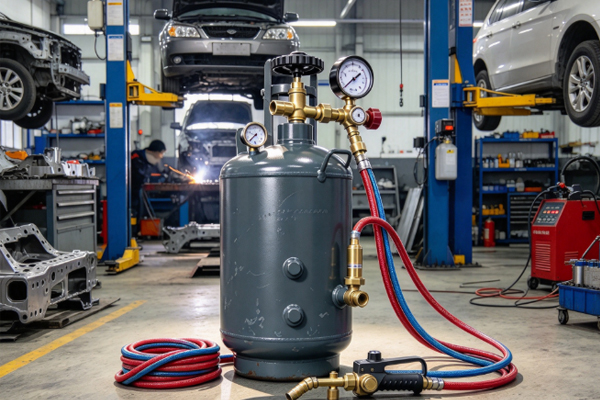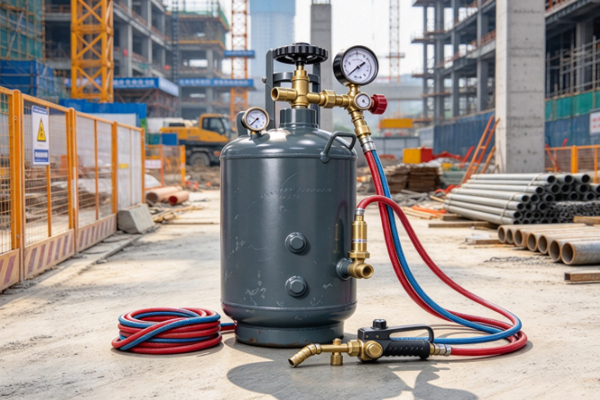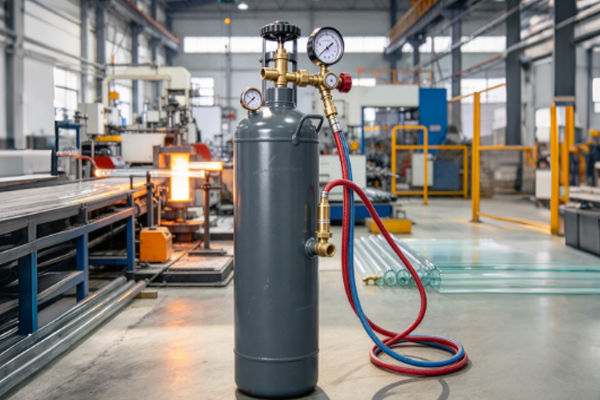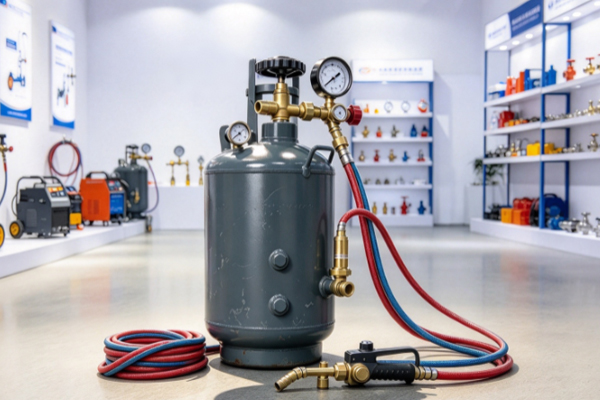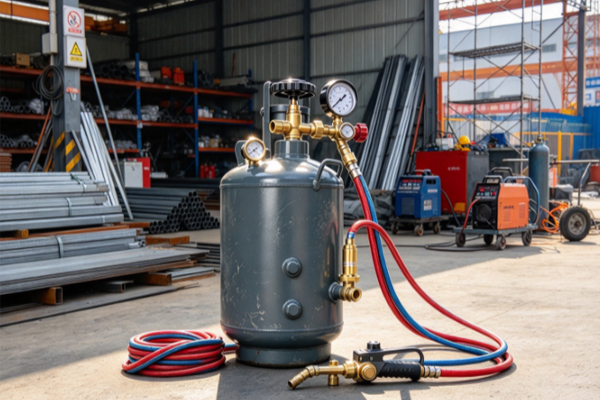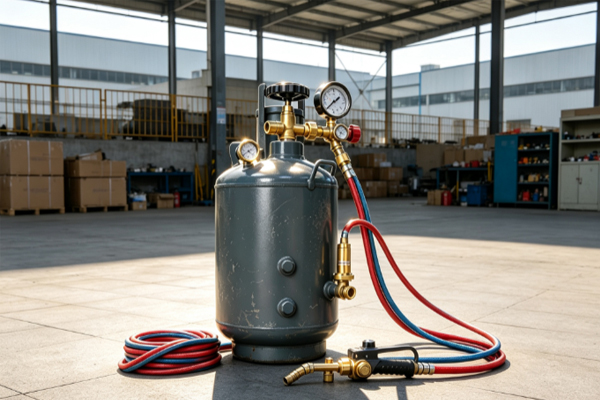
When buying an acetylene storage tank, one of the most practical questions is often, “How tall is it?” A workshop needs enough installation space, transportation requires suitable vehicle capacity, and operators need enough room to connect and manage the equipment. Many customers search for the height of a standard acetylene storage tank, but there is an important distinction: an acetylene cylinder and a large acetylene storage tank are not the same thing. Their capacity, structure, and applications are different, so their dimensions are different too. A common 40L acetylene cylinder is around 1 meter tall, but the exact size depends on the specific model and manufacturing requirements.
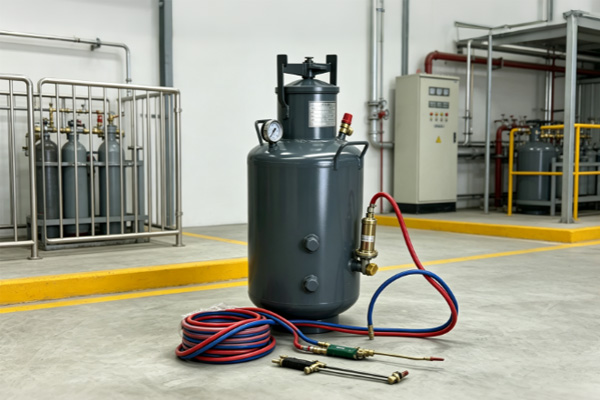
How Tall Is a Standard 40L Acetylene Cylinder?
If you mean the acetylene cylinders commonly used for welding and cutting, the 40L specification is widely used. GB/T 11638-2020, the Chinese standard for acetylene cylinders, covers cylinder specifications, technical requirements, filling, transportation, storage, and use. However, it does not simply require every 40L cylinder to have exactly the same overall height.
- A common 40L acetylene cylinder is about 1050 mm tall. Some specifications for 40L welded steel acetylene cylinders list an overall height of 1050 ± 10 mm and an outer diameter of about 250 mm.
- Actual dimensions may vary slightly. Even with the same 40L capacity, differences in cylinder construction, design, and accessory configuration can affect the final height.
- Height is not the only specification to check. Buyers should also confirm nominal capacity, outside diameter, weight, working pressure, connection type, and applicable standard.
- Leave additional installation space. If the cylinder will be installed with brackets, piping, or additional accessories, the required space will be greater than the cylinder height alone.
For an initial space estimate, a 40L acetylene cylinder can be planned at around 1.05 meters in height. For actual purchasing and installation, however, the supplier’s product drawing and final specifications should always be used.
How Much Does Height Vary Between Different Acetylene Storage Tank Sizes?
There is no single height that applies to every acetylene storage tank. GB/T 5100-2020, the Chinese standard for welded steel gas cylinders, provides recommended nominal capacities and nominal diameters for welded steel gas cylinders ranging from 1L to 1000L. As capacity increases, the corresponding cylinder diameter and overall dimensions also change.
- Smaller-capacity products are more compact and can be easier to move or install where space is limited.
- The 40L class is a common size for on-site applications, with many products standing around 1 meter tall.
- Larger-capacity products have greater diameters and overall dimensions, so the height of a 40L cylinder cannot simply be used as a reference.
- For cylinder manifolds, centralized gas supply systems, or larger acetylene storage equipment, the overall height can also be affected by brackets, piping, valve groups, and safety accessories.
When requesting a quotation, it is better to tell the supplier the required capacity and application. Asking only “How tall is it?” can easily result in a number that sounds precise but does not actually fit the installation site.
How Much Installation Height Should You Reserve for an Acetylene Storage Tank?
When planning an installation area for acetylene equipment, measuring the cylinder height alone is not enough. Space is also needed for valve operation, piping connections, inspection, maintenance, and handling. For centralized gas supply systems in particular, the layout of piping above and beside the equipment can change the final installation dimensions. Acetylene cylinders also need to be stored upright and properly secured rather than being laid down or stacked simply to save space.
- Measure the actual clear height first. Check beams, overhead piping, door frames, and other obstructions so there are no surprises after delivery.
- Check the cylinder diameter too. Having enough vertical space does not guarantee that the cylinder can be positioned and operated properly. Access routes and working space matter as well.
- Allow room for valves and piping. The final height may increase after the gas connections and piping are installed.
- Include the securing system. Brackets, clamps, anti-tip structures, and other fixing components also take up space.
Once the installation location is decided, ask the supplier to provide an external dimension drawing for the exact model and compare it with the available site dimensions. This is much more reliable than simply using a “standard height” found online.
What Should You Check Besides Height When Buying an Acetylene Storage Tank?
If you are purchasing an acetylene cylinder, GB/T 11638-2020 applies to mobile refillable acetylene cylinders with porous filler, a maximum limited pressure of 1.56 MPa at a reference temperature of 15°C, a maximum allowable temperature of 40°C, and a nominal capacity of no more than 100L. If the equipment referred to as an “acetylene storage tank” is actually designed for centralized storage, manifold gas supply, or industrial acetylene storage, the dimensions of a 40L cylinder should not be treated as the dimensions of the complete system.
When purchasing, confirm capacity, outside diameter, height, weight, connection type, working pressure, accessory configuration, installation method, and applicable standard together. For export orders, bulk purchases, or fixed installations, it is also a good idea to request a complete dimensional drawing and technical specification sheet before reserving the installation area.
There is no single height that applies to every acetylene storage tank. A common 40L acetylene cylinder can be estimated at around 1050 mm tall, but actual dimensions vary by model and construction. For purchasing, the acetylene storage tank dimensions should be based on the specific product drawing. If the project involves larger storage or a centralized gas supply system, brackets, valve groups, and piping should also be included in the space calculation. That way, you avoid the awkward situation where the cylinder fits the space but the complete system does not.